Wednesday, 30 September 2009

Updates

Interesting. Two updates on articles that appeared on the Contrast blog recently.

Christian Lacroix, as I wrote at the beginning of the month, is currently in a state of limbo. Last anyone heard about the company, the Borletti Group, a group that currently backs two Italian department store chains, was going to place a bid. Now it's been reported by WWD that an Ajman sheikh has placed a bid. Unlike previous bidders, this mystery man would allow Lacroix's couture business to remain intact.

Also, the Daily Mail is reporting that fast fashion is losing its legendary popularity in Britain. We at Contrast have already written twice about the dangers of fast fashion. According to the new Daily Mail article, High Street "supermarkets" are starting to drop the cheap, ill-made lines and expand into more expensive territory--dresses, knits, and such. This shift is partly because customers are now buying more expensive clothing that will last longer. In addition, the supermarkets want to attract a more "middle class" customer. What, so the poors don't deserve pretty, well-made clothing? If only there was a way to get cheap, nice clothing without exploiting or excluding anyone. A girl can dream, right?

Tuesday, 29 September 2009

Only at Vassar...

FROM CAMPUS SECURITY---

A rare historical preserved kiwi bird has been removed from Olmsted  
Hall.  The bird has been treated with arsenic and should only be  
handled by trained personnel equipped with proper personal protective  
equipment.  Arsenic is very toxic and can cause significant health  
problems if materials containing arsenic or arsenic dust  are not  
handled properly.
---
I can't be the only one who thought this was hilarious.

Monday, 28 September 2009

Who Called It?

Editor's Note: This article was originally written in late May for the Chanel Resort 2010 collection. However, due to technological problems and general laziness, it remained sad and forlorn on my hard drive. Alberta Feretti's Spring 2010 collection reminded me that I still had this article, and no, I was not crazy because Edwardian is totally becoming a trend so hah! Hope you enjoy this article--better late than never!

Earlier this week, I wrote a post commenting on certain Edwardian predilections at the White House Press Correspondents dinner (with a heaping does of eye candy, of course). With the release of photos from Chanel’s Resort 2010 show, it’s official: Edwardian is in style!


Style.com

I’m pretty sure that Kaiser Karl was receiving my brainwaves while I was asleep because I swear this collection was made for me. It combines all of the prettiest things in the history of ever: Venice, Renaissance clothing, Edwardian clothing, and the 30s cafĂ© scene.

According to Lagerfeld, the collection is based on Chanel’s time in Venice, where she summered throughout the 1930s. The collection draws inspiration from Venice’s past, from Baroque masqueraders to Titian’s sitters. The collection includes other elements too, such as outfits inspired by gondoliers, and a dress clearly meant to evoke Fortuny, the early-20th century anti-fashion designer who famously based his creations around Venetian Renaissance dress. The collection is dominated by white, black, red, and gold—Venice’s city colors. Most of the models wear red tights and short frocks, evocative of the dress of the city’s nobility in the Renaissance.

But the most interesting thing of all is the Edwardian influence in the collection. From the opening dress to the stunning evening gowns, the draped cloth, empire waistline, and sensible shoes recall nothing more than Chanel’s rival, Paul Poiret. Poiret’s style was very feminine, colorful and ornate. When Chanel started designing in 1920, her goal was to move away from that ideal and celebrate the new, slender athletic woman. (Allegedly, when Poiret once saw Chanel in her usual black, he asked her, “Madame, for whom are you mourning?” She replied, “For you, monsieur.”)

This resort collection has the clear, straight lines that the house is famous for, but embraces the fantasy and fun of all that she rejected. My favorite piece, a white lace shift with ersatz draping, reminds me of the best of Alfons Mucha. It’s curious to me that in this collection Lagerfeld so willingly embraces everything that Chanel rejected. But I don’t care: this past decade has been a Magical Mystery Tour of the 20th century. We might as well take a pit stop in the 1910s while we can. Empire waist, Asian prints and Louis XIV heels, here I come!

Keep It Fresh, Keep It Classy: Go Bold


GQ


Ok kids, GQ’s latest blurb on this subject was the final confirmation of something I’ve been trying for quite some time now. Maybe it’s a rainy day, and you’re wearing some muted colors to match the weather. Maybe you just feel like sporting something simple and not too flashy (I know I do). Either way, we want to look good and be comfortable, a hard combination to pull off in any situation. What’s a good way to give our outfits a little “umph” without making it look like we’re trying too hard? Here’s a quick and easy one: go bold on the socks. I don’t mean buy those outrageous “toe-socks” that little twelve year olds wear or anything like that. Get some socks with some color. They could be plaid, striped, or polka dotted. The whole point is to break some rules. Barely any of my long socks are plain and boring (some are, but hey, there’s a time and a place for everything). But wait there’s more! Here’s the “not trying too hard” part. If you truly want to stay classy while going bold, make sure at least one color on your socks matches a color on something else you’re wearing. Do this, and you can break some fashion rules and never get called on it.  

--Mazi Kazemi

----

Mazi's new column, Keep It Fresh, Keep It Classy, is the latest addition to the Contrast blog. He will write about trends in men's fashions. Please give him a warm welcome! --Ed.

Sunday, 27 September 2009

Reel To Real #1: Anna Karina in "A Woman is A Woman"

Let me formally introduce this column: I'm Zoey, freshman and hopeless cinephile. Reel to Real is meant to give Vassar students fashion inspiration from great films. We often watch movies and lust after the character's wardrobes; i'd like to show how you how you actually can copy some great looks. Fashion magazines constantly feature looks inspired by the same group of actresses (Audrey, Marilyn , ect), but so many great actresses are waiting to be discovered. Please post pictures of outfits you put together that are inspired by these lovely ladies (and sometimes men) in the comments section!
First up is my favorite fashion icon, French New Wave Star Anna Karina in "A Woman is a Woman." Her style in all 7 films she made with director Jean-Luc Godard is iconic, so i will probably end up featuring them all! Godard's films were made on a low budget, forcing Karina to wear her own clothes. This makes her style genuine, as opposed to the ovbiously styled looks in contemporary film. 
Karina's look makes modesty sexy. Her character in this particular film, Angela, is a stripper, but even her performance outfit manages to look sweet, not hypersexual:

As you can see, the nautical look is a staple of Karina's wardrobe. A few nautical details, like rope or red/white/blue ribbons will help you achieve it without looking like a castoff from Fleet Week. Karina always has at least one bold primary color in her outfits, so if you are wearing all black, pull on some red or blue tights! Here was my attempt to copy two of her outfits:

The plaid/schoolgirl look is also an essential part of the Anna Karina persona. Always keep it simple with some bursts of primary color. This includes long (knee-length) full skirts, cardigans, Mary Janes, black ballet flats,and knee socks. here are some Karina-esque pieces:


Here are some more pictures to inspire you. Anna's look is the perfect mix between classic and whimsical, but you really can make it your own, as I did in the picture above.


Don't forget the makeup: blue eyeshadow and liquid cat eyeliner. For a school day, this can easily be toned down. 
But most important is the right attitude! Anna isn't such a great fashion icon becuase of the clothes she wears but becuase she wears them with such charm, as you can see in this picture:

Saturday, 26 September 2009

Milan Fashion Week: Alberta Ferretti


All images Style.com

In a season that's presented an endless, seemingly identical array of screaming sequins, loud leather, and rampant nostalgia, Alberta Ferretti has done the world the service of sitting back and just saying, "No." Instead of a collection full of the desperate sexuality of a people run amok in an unsure recession, Ferretti has taken us back to a more distant but no less fraught time: 1919 and 1920 to be exact. (Do I smell an Edwardian sub-trend? Pretty please with sugar and sprinkles on top!)

Ferretti's collection has tons of romantic chiffon numbers with an air of melancholy about them. The wide waists and lace recall the Armistice period in late Edwardian fashion. The velvet decorations and large Art Deco prints are a nod to the very early 20s, a time hellbent on delivering as much romantic flair as possible. In a way, this post-World War I look is even more challenging than our 80s and 90s revivals. These women and the men around them were trying to reconfigure their sexual identities after a debilitating war that proved that women could work in factories and earn money and that masculine bravado--the creator of so much wanton destruction across Europe--was nothing but an empty shell. Women were relearning how to be women, but they were also, for the first time, gaining that masculine independence that the 80s club girls wandering around next spring take for granted. So let's tip our hats to these brave women and honor them through beautiful, classic but no less adventurous clothing.


Look Ouuttttttt It's Spider Goat!


Fred R. Conrad/The New York Times

 This incredible piece of fabric pictured above looks like it could be any 11-foot long, beautifully woven piece of golden silk. But what if I told you that it's not made from spider's silk? Randy Kennedy profiled Simon Peers, a British art and textile historian living in Madagascar, and Nicholas Godley, a fashion designer also based in Madagascar. The somewhat unlikely pair met when Mr. Peers decided to investigate whether the native tales and colonial accounts of the female golden orb spider were true: that they could create a golden hued silk, and that its tensile strength was five to six times that of steel. Mr. Godley got involved when, one day, while visitng Mr. Peers's office, he noticed a weird metal spool, a reproduction of the kind that had been used to harvest the spider's silk a hundred years earlier. The two came up with a plan to produce the silk--as a designer and businessman, it was in Mr. Godley's best interest to find a long-lost local art, and as a scholar Mr. Peers was trying to revive Madagascar's weaving arts. Half a million dollars later, the team--with the help of local artisans--has made what the Natural History Museum claims is the first recorded piece of textile made entirely of spider silk. It is on display in the Grand Gallery until April.


But lest you think that spider's silk is just some quaint folksy craft, allow me to introduce you to the 21st century version: spider's goat milk, or Biosteel. Basically, this company called Nexia--working with the U.S. Army--has figured out a way to insert a spider nucleus into the egg of a goat. When the parent goats breed, the kids will look just like goats--except their milk will have the tensile strength of a spider's web. Nexia claims that this material will be biodegradable, stronger than steel, and lighter than a lot of petroleum-based polymers. The material could be used to create artificial human tissue, aircraft parts, tiny sutures for eye wounds, or bullet proof clothing. You guys, I really wish I was making this up, but no. The future is now.


Related:

Thursday, 24 September 2009

Stolen Jewels


If you subscribe to Madonna's "Material Girl" motto, dig pixelated images, and feel that stolen stuff is just plain cool, then you'll drool over MikeandMaake's Stolen Jewels collection. Stolen Jewels features low-res images of some of the most expensive jewels on earth "stolen" from the web (using google image search), doctored, enlarged, and then printed onto scored leather. The price of the collection ranges from 250-750 dollars, a real steal when compared to 350 million dollar sticker price of the real Hope Diamond, which they've reinvented as a broach. Even though I still can't afford these, I do appreciate the craftiness, playfulness and overall stolen-ness of MikeandMaake's Stolen Jewels.

Wednesday, 23 September 2009

Detroit: U.S. Fashion Capital?

New York Fashion Week has gone and everyone who's anyone is in London, right? Not so fast, says Jessica Coen of The Cut. This week just saw the fourth annual Detroit Fashion Week. According to Brian Heath, founder and producer of the event, Detroit is a national fit for the fashion industry. Huh?

It actually makes a lot of sense. As Detroit's car manufacture industry is dying, there are lots of designers and factories who need work. Why not go with fashion? As I've already mentioned, fashion is a very, very cheap industry to get into. Detroit is a much cheaper place than the City--cheaper labor, cheaper overhead, cheaper rent, cheaper, well, everything. And as the demand for more American-made clothing grows, Detroit will be able to pick up the slack from the shrinking Garment Districts in New York and LA.

What do you guys think? It's high time to change the traditional views of American fashion, hmmm?

Pump It Up!

When you see a pair of pretty, pretty Loubs, do you run home and cry into your pillow, cursing the patriarchy with every breath? Do you not wear high heels because you're a pinko commie socialist  man-hating lesbian bull dyke feminazi? No? Well the folks at the Today Show think the answer to those questions is, "yes"!


So, the premise of this clip is pretty simple: intrepid reporter goes around asking random people in Grand Central Station if high heels are "empowering" or "oppressive." (NB: Some random smarmy dude from America's Got Talent is subbing in for Kathie Lee.) This is not the first time Hoda and Kathie Lee have completely dumped on [their misconceptions of'] feminism. (And please take a look at what Jessica Valenti is wearing. OMG, that feminist is just soooooooo manly!)

This "story" is offensive on several levels. First, it erroneously conflates empowerment with sexiness. One of feminism's goals is to make sure that women feel comfortable and happy about their bodies. In that sense, feeling sexy is a form of empowerment. But it's not empowerment in and of itself. Secondly, by asking if high heels are "oppressive" it is forcing the random person on the street to think that there's some secret cabal forcing women to wear high heels for their own dastardly ends. And, if framed that way, the answer to that question is obviously "no," because as feminist scholars have been trying to prove for the last 30 years, oppression is not necessarily a conscious act--women, in fact, can participate in their own oppression. Crazy! The third flaw of this segment is that they only speak to women who are already wearing high heels because they have desk jobs. The woman in the fashion industry likes them, but obviously can't wear them because of the nature of her work. Yet, unlike what the "experts" say later in the video, this does not make her any less successful. Obviously, anyone who willingly wears heels on an everyday basis wears them because they like them. So all of those women are going to answer that yes, wearing high heels are "empowering." Whew, question solved: high heels don't enslave women! Thanks for that hard-hitting journalism, you guys!

Now, the act of wearing heels is not oppressive in and of itself. In the past, I suppose that critics of the stiletto have claimed that they disempower women because it forces us to hobble--you can't really do anything in those shoes except strut. Or, one could say that they're oppressive because really the only woman who can wear them is a lady of leisure and yet all women are expected to wear them. The first argument is false, in a way, because men are physically able to wear stilettos, they just don't for a host of reasons. If men wore heels, they would be similarly restricted. Maybe random dude from America's Got Talent should walk around in the shoes that made Hoda cry and see how sexy he thinks heels are then. The second statement is false because, at this point in time in history and fashion, the high heel has become a symbol of power for the working woman. She isn't sitting around eating bon bons in her expensive shoes: she's working at a desk, and she has the option to take them off.

But what is oppressive is behaving as if not liking or wearing heels is some kind of crime against womanity, like you won't get ahead at work if you don't wear them. The way the question was framed, you'd have to be crazy to think that a simple shoe could oppress half of the world's population. And notice that they didn't ask any women wearing sneakers or flats. Maybe those silent women change into nicer shoes when they're at work--because really, why would you be stupid enough to wander around the New York City subway system in three-inch heels? I marvel at the woman who can do that--truly she is a superhero. (To be fair, the article that goes with the segment suggests this, but that is not the message implied in the video.)

And does no one find it disturbing that, according to Lea Goldman, features editor at Marie Claire, and Helen Fisher, an anthropologist at Rutgers, a woman's success in the working world is inextricably bound to her attractiveness, as defined by some vague idea of "normal" heterosexuality? If you wear flats, clearly you're just Dowdy McDowderson and won't get that promotion because you're not hot enough. Have these "experts" and "journalists" thought that maybe some women just don't wear stilettos to work because they think they're uncomfortable or impractical, or they're waiting for a nicer style of shoe to come along, or they physically can't wear high heels, or--horrors!--they just don't like high heels, and they aren't completely crazy for thinking that way? Because it's really insulting to be told that there's only one way a woman could be sexy, or that there's only one way someone can find a woman attractive, and that men are only interested in a woman's brain if it comes in a hot little package. That thinking is oppressive.

In her book Sex and Suits, Ann Hollander defines fashion as what society has told us is the "right" thing to wear at that point in time. We are very lucky in that, as the video above points out, fashion is telling us that women can wear heels for our own pleasure and not, as in decades past, to please hubby. But we just can't divorce ourselves from the sexist notions surrounding this frickin' shoe. And that makes us unlucky indeed.

Edit: You guys, I think the America's Got Talent dude has some serious sexual hangups.

ViCE After Hours Auditions Fall '09

This Saturday, September 26, 2009, ViCE is holding auditions for After Hours in the College Center MPR from 12 PM-5PM. There's a sign up sheet on their office door. Questions? Concerns? E-mail them at viceafterhours [at] vassar.edu

Monday, 21 September 2009

Noted and Quoted

"I was never in the high, high fashion industry. I was never one of those superskinny, supertall waif girls who goes from show to show. When you do more commercial things, your weight is allowed to fluctuate a bit. Not every inch counts....It's hard for the girls. How old are they? Fifteen, 16? Some girls are naturally thin and can eat whatever they want. When I was 15, 16, there was not one ounce of fat on me, but some other girls have to work hard to stay like that. But the rules are not made by the models. To be part of this, they have to be the size the designer wants them to be. I'm not that skinny, and I never was, but I can pretty much eat whatever I want."--Heidi Klum

Obsessions: Obama's Facebook Feed

Slate does this thing every week where they round up the President's activities for the week in the form of a Facebook feed. I think I'm in love. But are you telling me Rahmbo doesn't like The Vampire Diaries?!

----
Have an Internet obsession you want to share? (Because who doesn't like to procrastinate?) E-mail me at cecholst [at] vassar.edu

Sunday, 20 September 2009

Rules and Guidelines

Okay, listen up! Here are the blog's rules and guidelines:


Ohohoho: I can post as many photos of my beloved Rahm Emanuel as I want because I'm the blog editor and you can't stop me. Image from HillBuz

1) Submissions

Please send your submissions to the blog editor, whose e-mail is on the upper right hand corner of the screen. Any member of the Vassar community can submit an article, an ad for an event, or artwork--whatever, as long as it reflects culture and style in and out of the Vassar bubble.

The editor reserves the write to make small revisions to your submission.

2) Citation Guidelines

Please cite all sources. For photographs, write the name of the source in small print under your photo. If you are citing an article, please mention the author of the original piece and include a link. If you are using a source from a service that requires a subscription--such as Women's Wear Daily or the New York Times--please quote the part of the article you are responding to, either in the main body of your article or as a footnote. Finally, please include all your sources in the tags.

3) Commenting

No foul language, no personal attacks! Constructive criticism only.

4) Language

Please keep it civil and PG-rated.

Friday, 18 September 2009

We want YOU!

We're looking for columnists for the blog! The columns can be on any subject you please--as long as it relates to style or culture. Interested? E-mail me at cecholst [at] vassar.edu.

Play hoops for a great cause: Dunk for Darfur

DUNK FOR DARFUR
Saturday September 26th, 2009

WHO: Vassar College STAND chapter address issues of genocide in Darfur and all over the world. Dunk for Darfur is an event for students, faculty and members of the Vassar College community.

WHAT: A 3v3 basketball tournament to benefit the victims of the genocide in the Darfur region of Sudan. $10 registration fee per player (up to 4 on a team). Registration fees will go directly to the Genocide Intervention Network. There will also be a raffle, music, and other contests, including one-on-one against a varsity player!

WHERE: Vassar College Athletic and Fitness Center gymnasium.

WHY: Though we say never again, genocide is still all around us. Show that you care. Show that you want to do everything in your power to not only protect and aid the victims of the current human rights conflicts and genocide that plague the world, but to PREVENT further atrocities.

For more information, check out our website at dunkfordarfur.webs.com.

Send your team name, members, email address and mailbox number to dunkfordarfur@gmail.com to register!

-----

Got an event you want to advertise? E-mail the editor: cecholst [at] vassar.edu

Hot and Bothered

The Shiva Rave may have been two weeks ago but here are some sweaty and sticky photos to remind ourselves of the those hotties we brushed up against:


All Photographs by Madeline Little

Thursday, 17 September 2009

Model Casting Call!

Wanna be a Contrast model? Come to Joss Parlor this Sunday, September 20th, starting at 2 PM. Oh, and tell all your friends. We're looking for all shapes, sizes, and colors. This magazine is about you, after all.

NYFW: Tadashi Shoji


It's all in the details for Tadashi Shoji

Celebrities ranging from Blake Lively to Beyonce turn to Tadashi Shoji for carefully embellished, elegant frocks, and his latest batch of dresses is certain to please all his loyal followers. The Los-Angeles based Japanese designer zeroed in on his niche market of luxury pieces for his Spring/Summer collection. Inspired by Kenro Izu’s photography book Passage to Angkor, Shoji incorporated qualities of the famed Cambodian temple into the colors and fabrics of his designs. The delicate beading and elaborate draping on the dresses that floated down the runway are a nod to the winding banyan tree roots near the temple, which represent continuous growth and rebirth. While the color scheme was decidedly dainty-hues of champagne, ivory, and pearl ruled- these dresses are not for the faint of heart. Skintight and thigh high, a major dose of confidence is necessary before slipping into one of Shoji’s creations. All qualms aside, Shoji’s beautiful collection of special occasion pieces proves to be worthy of the spotlight. (image via Coutorture)

Tuesday, 15 September 2009

Got something to say?

We want to hear you! Articles, essays, event advertisements, photos, art projects...anything! And P.S. This Editor is looking for columnists. E-mail your stories, ads, or art to cecholst [at] vassar.edu.

Also: please write comments so I know you're out there. It isn't much of a blog if there's no dialogue, right?

Monday, 14 September 2009

Fair Trade: Investing in Women

Like every industry, the fashion world has suffered severe casualties since the start of the recession. Interestingly, fair trade goods--usually more expensive and specialized--appear to be weathering the storm. According to Amber Chand, the owner of the Amber Chand Collection, in an interview with NPR, her business has expanded by 22% this year.

Chand is a refugee herself, having fled Uganda during Idi Amin's reign of terror. Now, she says, she looks through the newspapers to identify a source of conflict:

"I swoop in and then identify a group of talented, skilled artisan women who live there [in conflict zones] and who are clearly going to have to rebuild their lives in the shadow of either war or genocide or civil strife."
 
 When we buy fair trade products, Chand explains, we are actually investing in these women. But here's another point Chand did not make: while, yes, it's important to provide a source of income to a disadvantaged group, these business arrangements also help women gain economic independence and social respect. We as a society can put all the factories we want in developing nations but that alone will not improve those nations' economies. Fair trade arrangements provide women with a financial education: once they learn how to run a business, they can teach their daughters to do the same, they can expand their businesses, and they can climb the social ladder. Through fair trade, developing countries can eventually form healthy capitalist economies without serious cost to human dignity and--even better--with the equal participation of women. Pretty sweet, right? If you're interested in helping disadvantaged women around the world but don't feel you can afford fair trade goods, you can lend money to a specific entrepreneur at kiva.org (minimum loan is $25 and you will be paid back). Vassar always tells us to give back to the community--it's about time we made a start.

How Do You Put on a Show?

Forbes has a nifty little chart listing all the people who help put on a runway show. Apparently, McDonald's is a Fashion Week sponsor?!

Thursday, 10 September 2009

So You Want to Be a Fashion Designer?

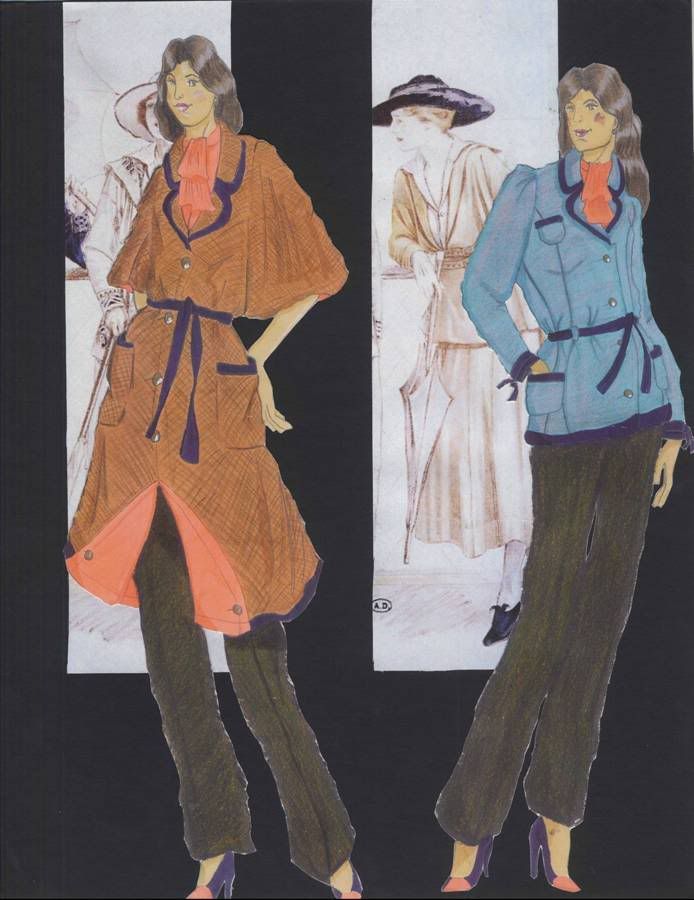
Two summers ago, I took a design course at the Fashion Institute of Technology in New York. That summer, I happened to be interning with two designers (with one designer, the collection I worked on ended up in Vogue, while the other has appeared in W, i-D, and Muse). The only thing I knew about fashion was that it was prejudiced against 5'6", 150 ibs, big-boobed people like me and I spent a lot of time in high school designing things that could be worn by all body types. So, I could draw... and that was it. Through my internship, I learned how to swatch fabric (still my favoritest thing to do) and saw how the industry worked. With the FIT class, I actually learned how to design.

I took the Drawing and Illustration I class, taught by Anna Kiper, a former designer for Calvin Klein and currently a freelance designer and professor. Besides me, there was only one other girl who wasn't an FIT student/prospective student. She was an art student. I, as a Medieval and Renaissance Studies major, was the odd one out. (But this summer, Joan Rivers thought my major was totally cool, so you can all suck it.) Everyone else had either gotten in to the full time program (which is very difficult), or was directed by admissions to take this class as a remedial course and reapply in the fall.

We learned how to do draw the fashion figure (a horrible abomination--9 heads tall instead of the realistic 6 1/2-7, completely out of proportion but supposedly, when drawn on 11"X14" paper, 1/5 of the size of the actual garment. Whatever.); how to draw a 3/4 view face and figure; how to do fashion research; how to swatch; and how to render tweed, twill, herringbone, and checks.


Click the image for the rest of the gallery!


The first project was to do a 60s bathing suit line. When my professor said 60s, she meant those impractical cut-out bathing suits that have stumbled their way back into style. I was all, "Hells no" and decided to do something with a mix of early 60s Jackie Kennedy and late 60s Italian hippies.

The second project had a bit more freedom. We were to draw the figure in 3/4 view in an evening gown: the only requirements were that the dress had a bustier and a mermaid gown (i.e. a small train.) I, of course, went the Alfons Mucha route, because really, he's just the best. (This image was my inspiration.)

The final project was known as the Chanel Suiting Project. Basically, pretend you have complete control of the House of Chanel for a season. What are you going to design? We had to do a blouse, pants, a skirt, a jacket, and a coat. This project was meant to instill in us the joys of merchandising-- that is, making sure that all pieces in your collection go together both visually and physically. This was actually my favorite thing after swatching. We also learned how to render texture. I am not really a fan of Chanel (for reasons I will explain in a later post), but I remembcombine those late Edwardian designs with her love for military uniforms and got something that was both very Chanel and very yours truly. For that project, I swatched a salmon silk charmeuse for the blouse and skirt lining; a pink, turquoise, gold, and brown tweed for the jacket and skirt; a luxurious brown wool for the coat; and purple felt for the trim.

If you are interested in design, I highly recommend taking a class at your local state university, whether it's FIT or a less famous school. The classes are very cheap (as a resident of New York state, my FIT class was a pittance at about $300 for three weeks) and the quality is excellent. I stupidly transferred the credit for this class from FIT to Vassar, but I hope that, if I go for a second degree at FIT, I can transfer the credit back.

I worked nearby FIT this summer. Every time I passed by, I couldn't help but feel a ping of regret. Who knows, maybe someday...

P.S. As I hope you can see, I can actually draw faces. When I did the bathing suit project, I was all, "Oh, well the faces don't matter as much as the clothing." Wha wha. I was wrong. But really, I can draw people!

---

Do you have an art or design project you want to exhibit? E-mail me at cecholst [at] vassar.edu.

Wednesday, 9 September 2009

It's All in the Details

Some distressing news courtesy of Gawker.

My fave cover. ever.

If you're not a Conde Nast devotee like myself, you may not have heard this, but the publisher has recently hired McKinsey consultants to come into the offices and do a drastic overhaul in order to make the magazines more cost-effective. For a long time, the luxury mags at Conde were able to maintain huge budgets partly because the same publishing company had a pretty stable income from newspapers sales. Of course, newspapers at this point are starting to look more and more like cave-paintings: unappealing, outdated, and you can see the same thing online for free.

So now the decades-long media/fashion/celebrity blitz seems to be slowing down in the Conde building, and all the perks of working there are dropping away. The majority of the receptionists have already been laid off, and the McK consultants haven't even given their final report yet. Gawker thinks big-spender Vogue will have it's budget seriously curtailed. Apparently Details is also in a difficult position, since the consultants are looking to eliminate any redundancy, and as Belonsky writes, "Details should be sweating in its Italian boots, because it's basically a younger-looking carbon copy of GQ." I would qualify that. Younger, and slightly gayer.

I interned at Details two years ago, and it was a pretty fantastic experience. I could see how someone could consider the magazine 'redundant', existing as it does in the shadow of GQ, but for my money I'd always buy a Details first. Maybe they should take a few tips from Nylon Guys and tackle the hipster market.

GENERAL BODY MEETING

Hey, everyone! There will be a general body meeting Wednesday, September 9th at 8 PM in Rocky 300. Be there, and make sure you aren't, ahem, fashionably late. (Sorry, couldn't resist the pun.)

Monday, 7 September 2009

At What Price Progress?

Today an editorial by Nanette Lepore and Robert Savage appeared in The New York Times, championing the Garment District and its presence in New York City's economic fabric. (Sorry, pun not intended.) This editorial follows an earlier article that discusses Mayor Bloomberg's proposed plans for the beleaguered manufacturing area. Basically, thanks to outsourcing, the Garment District in New York--once the place where almost every article of clothing in the United States was made--now only takes up five blocks in the heart of Midtown. Now the Bloomberg administration wants to put every single garment factory in one or two buildings in the area, taking up a measly 280,000 square feet (currently, factories take up about a million square feet). The empty spaces previously occupied by the factories would be turned into offices, apartments, and cheap hotels, a move that would be to the landlords' advantage.

Putting all of the factories into one building just spells the death knell of the local industry. Confined to only a building or two, there would be no way for the district to expand. Factories would have to be small and specialized. Most manufacturing in New York is boutique anyway (and thus expensive), none of which helps new designers with little start-up money. Lepore and Savage propose that the city create a board to approve prospective tenants in Garment District buildings, rejecting anyone but manufacturers. Meanwhile, the unions Unite Here and Workers United--with the backing of the CFDA and city officials, among others--have proposed to create a non-profit organization that would maintain the designated buildings and offer manufacturers a significantly discounted rent for the space.

Lepore and Savage's concern must be taken seriously. Unite Here and Workers United's proposal is a decent compromise, but we must remember that a strong Garment District is the sign of a healthy economy. A quick study of any industrial revolution from the 16th century to the 21st will show that textile production and manufacturing has always been the key to growth and success. The textile industry requires relatively little capital and very little skill. To continue down our current path--designating mass production to developing countries and keeping small but technically difficult processes in industrialized nations--smacks of imperialism at best and racism at worst. Bringing mass production back to the States will bring back jobs and jump-start entreprenuerism. None of that can happen if we trap our factories in two small buildings.

Thursday, 3 September 2009

Noted and Quoted

"The reason I did fashion was it was the only way to get paid to do anything creative.... The only way you could be "arty" was as a fashion photographer, because it still had a certain amount of integrity involved. Now it's such a mass industry. They just churn it out. There's not much personality in it any more. You can't say, 'That's a Helmut Newton picture', because you don't know who took the picture. 'Who did the retouching?' is the question you ask. It makes mediocrity look good."

Wednesday, 2 September 2009

The Fall of the House of Lacroix

Fall Fashion Week has rolled around again but one important contributor is missing from the Paris shows: Christian Lacroix.


Image from Magnum

The photography
agency Magnum released some images from past Lacroix shows--a way to remember what has been lost and what can still be saved.

Lacroix did not exactly have a normal path as a designer. He initially went to school for museum studies in Paris but soon caught the eye of the fashion crowd. In the early 80s, he found a job at Jean Patou where he rubbed shoulders with Bernard Arnault, now at LVMH Moet Henessey Louis Vouitton. In 1987, Lacroix received funding from LVMH to start his own line. His first collection rocked the couture world: his bright colors and costuming techniques shook Paris from a dark, tailored rut.

Yet for all the praise he received from the fashion world, Christian Lacroix the company was never succesful. It went through 11 CEOs in about 20 years, Lacroix claiming that none of his backers ever wanted to put enough money into the company. Finally in 2005, the house was bought by the Falic Group, a duty-free airport chain. Obviously this is an odd choice of investor. Perhaps Falic wanted to enter into the fashion world, or it wanted to involve the house in lower-market branding opportunities. Due to the recession, Falic announced the comapany's bankruptcy in May of this year. The house hadn't turned a single profit in all the years of its existence. Falic slashed the company in size from 125 to 12 employees and has mentioned the possibility of selling ties, perfume, and the like in airport shops. This fate may have been averted when Borletti Group, yet another middle-brow investor (this time the owner of two Italian department store chains), placed a bit in late July.

Why is all of this corporate mumbo-jumbo necessary? Only to provide context for a wider trend in the fashion world. As this summer's Valentino: The Last Emperor also pointed out, the fashion industry tends to follow the financial world's business model du jour in ways that are not productive to the artistic process. In the 80s, it was licensing; in the 90s, mergers and diversification (for example, LVMH--both a fashion conglomerate and a champagne producer and exporter, among other things); now, it's public trading on the stock market. As fashion houses like Valentino and Lacroix get bought up by investors looking to turn a profit, artistic license will most certainly be compromised. Lacroix's clothing is clearly art--not always in the best taste, but still art--and commercial interests will only damage his reputation. Whether or not the designer recovers from this particular setback, it is very clear that the fashion industry has witnessed the end of an era.